
Iran Missile Claim Puts Focus on U.S. Base Defenses in Kuwait
A social media post claiming that Iran launched ballistic missiles at U.S. forces stationed at Ali Al Salem Air Base in Kuwait spread rapidly online, raising fresh alarm over the vulnerability of American military installations in the Gulf. As of publication, there was no immediate public confirmation from the U.S. Defense Department, Kuwait's government or Iranian state media that such an attack had occurred, underscoring the fog that often surrounds fast-moving military claims in the region. Still, the report has drawn intense attention because Ali Al Salem is one of Kuwait's most important facilities hosting U.S. forces, and because any direct Iranian strike on Kuwaiti soil would mark a grave escalation with implications far beyond the base itself.
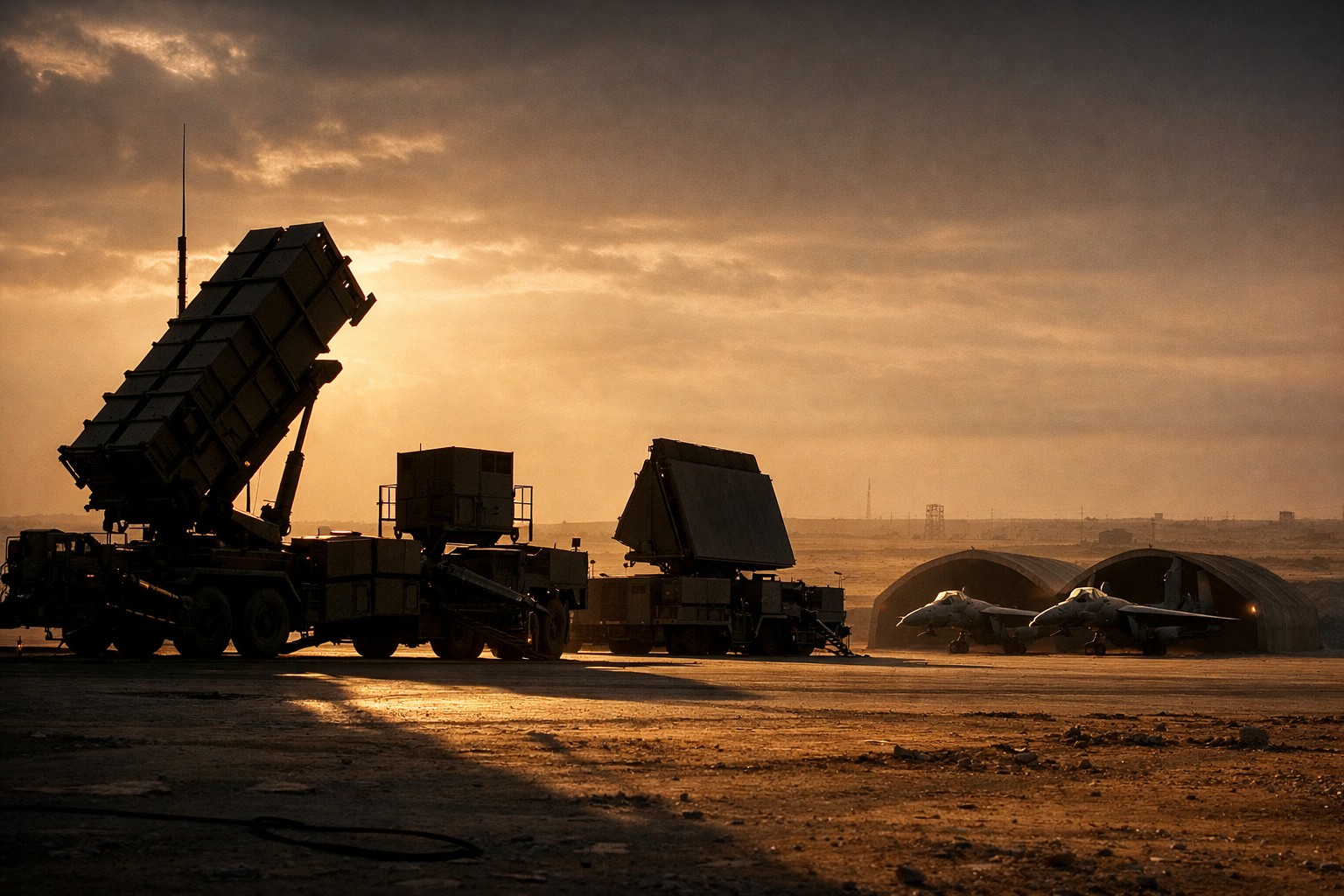
The claim also focused attention on the Patriot air and missile defense system, long a central part of U.S. and Gulf efforts to counter ballistic missile threats from Iran and its regional partners. In recent years, U.S. commanders have repeatedly warned that bases across the Middle East face a mix of missile, drone and rocket threats, while analysts say even successful interceptions can carry political and military consequences. The immediate question was not only whether missiles had been fired, but what a reported engagement over Kuwait would signal about the trajectory of the wider confrontation involving Iran, the United States and allied states in the Gulf.
Claim Spreads Before Confirmation
The report originated in a post on X by the account @visegrad24, which described the development as breaking news and said U.S. forces were using Patriot systems to attempt interceptions. Such posts can amplify genuine developments quickly, but they can also race ahead of official verification. In conflicts involving Iran and U.S. forces, initial reports have at times proved incomplete or inaccurate in the first hours after an alleged strike.
By publication time, no official U.S. statement had confirmed an attack on Ali Al Salem. The Pentagon has historically issued force protection updates cautiously, especially when operations are ongoing or when commanders are still trying to determine whether incoming projectiles were launched, intercepted or caused damage. Kuwait, which tightly manages public messaging on security matters, had not publicly detailed an incident in line with the claim.
The absence of immediate confirmation matters because ballistic missile launches are typically difficult to conceal for long. They are usually tracked by military sensors, regional radar networks and, in many cases, commercial satellite monitoring. Analysts say that if a ballistic missile attack on Kuwait had taken place, corroboration would likely emerge through government channels, eyewitness accounts, airline advisories or regional military alerts.
Why Ali Al Salem Matters
Ali Al Salem Air Base, located in Kuwait, is a key node in the U.S. military footprint in the Middle East. The installation has been used by the U.S. Air Force and coalition partners for air operations, logistics, surveillance and force sustainment, particularly since the Gulf War era and during operations linked to Iraq and Syria. Its strategic value comes from Kuwait's proximity to Iraq and the northern Gulf, as well as the country's longstanding defense relationship with Washington.
Kuwait hosts several important U.S. military sites and has long been designated a major non-NATO ally by the United States. The broader U.S. military presence there has served as both a deterrent and a staging platform, allowing Washington to move personnel and materiel quickly across the region. Any direct strike on a U.S. installation in Kuwait would therefore be interpreted not as an isolated tactical act, but as a challenge to the regional security architecture built over decades.
Ali Al Salem has often been described by U.S. military officials as a critical hub for expeditionary airpower. Facilities in Kuwait have supported aerial refueling, intelligence missions and the rotational deployment of forces. That makes them attractive in military terms to any adversary seeking to demonstrate reach or impose costs on the United States, even if an attacker does not inflict heavy physical damage.
- Ali Al Salem is part of Kuwait's broader role as a host for U.S. military operations in the Gulf.
- Kuwait has been a central logistics and basing partner for Washington since 1991.
- A successful strike there would carry military, diplomatic and economic consequences across the region.
Patriot Batteries Back in View
The Patriot surface-to-air missile system has been one of the most visible pillars of U.S. and allied missile defense in the Gulf for decades. Built to intercept aircraft and certain types of incoming missiles, later Patriot variants were upgraded to improve performance against tactical ballistic missiles. The system has been deployed extensively in Saudi Arabia, Kuwait, Iraq and other parts of the region in response to threats from Iran and from Iran-aligned armed groups.
Its record, however, has long been debated. Patriot batteries have intercepted missiles in multiple conflicts, including during the Gulf War and in later attacks linked to Yemen's Houthi movement, but experts caution that no missile defense system offers a guarantee. Success rates can vary depending on salvo size, missile type, flight profile, radar coverage and whether defenses are layered with other systems such as THAAD, Aegis or short-range point defense.
"Patriot remains a valuable component of regional air defense, but it is not a magic shield," said Fabian Hinz, a research fellow specializing in missiles and air defense at the International Institute for Strategic Studies, in prior public analysis of Gulf missile threats. "Iran's missile arsenal is large, diverse and increasingly accurate, which means defenses must be understood as risk reduction rather than absolute protection."
If Patriot interceptors were indeed fired over Kuwait, that alone would be significant. Interceptor launches can signal that military operators detected a credible threat track, even before governments decide how much detail to release publicly. They can also create complications for civilian airspace management and commercial aviation, an issue the region has confronted repeatedly during periods of heightened tension.
Iran's Missile Playbook
Iran has developed one of the Middle East's largest ballistic missile arsenals, a force it sees as central to deterrence against the United States, Israel and Gulf rivals. Over the past two decades, Tehran has invested heavily in short- and medium-range missiles, cruise missiles and drones, while refining precision strike capabilities that have altered military calculations across the region. U.S. officials and independent experts have repeatedly said these systems are designed both for battlefield effect and political signaling.
Iran has previously demonstrated a willingness to use ballistic missiles directly. In January 2020, Tehran launched missiles at Iraq's Ain al-Asad air base and another facility hosting U.S. forces in retaliation for the U.S. killing of General Qassem Soleimani. No U.S. service members were killed in that attack, but the Pentagon later said more than 100 troops were diagnosed with traumatic brain injuries, illustrating how even attacks without immediate fatalities can have lasting consequences.
That 2020 strike was widely seen as a watershed because Iran signaled its attack in ways that appeared calibrated to avoid all-out war while still demonstrating capability. Analysts say any reported launch toward Kuwait would be judged against that precedent. Was it intended to inflict casualties, send a message, test defenses, or trigger a broader confrontation? Without verified details, those questions remain open.
- Iran fields short- and medium-range ballistic missiles capable of reaching U.S. bases around the Gulf.
- Tehran has used missiles directly against U.S.-linked targets before, most notably in 2020.
- Military analysts say Iran often blends deterrence, retaliation and political messaging in its strike doctrine.
Kuwait's Delicate Balancing Act
Kuwait occupies a particularly sensitive position in Gulf politics. It is a close U.S. security partner, but it has also often sought to maintain measured relations with neighboring Iran and to position itself as a pragmatic regional actor. That balancing act has become harder whenever tensions between Tehran and Washington spike, because Kuwait's geography and military hosting arrangements place it close to any crisis.
For Kuwaiti leaders, even an attempted strike would raise difficult questions about deterrence, sovereignty and domestic reassurance. Kuwait has generally avoided the sharper rhetorical confrontations seen elsewhere in the Gulf, preferring diplomacy and caution. Yet an attack on its territory, especially on a base hosting U.S. forces, would almost certainly force a stronger security response and more visible coordination with Washington.
"Kuwait has long tried to avoid becoming the front line of a U.S.-Iran clash, even as it remains indispensable to U.S. military planning," said Kristin Smith Diwan, a Gulf scholar at the Arab Gulf States Institute in Washington, in previous public commentary on Gulf crisis dynamics. "That tension defines much of Kuwait's strategic posture."
Any confirmed incident would also likely prompt scrutiny of Gulf air defense integration. For years, U.S. officials have pushed partners in the region to share radar data more efficiently and to coordinate early warning systems, arguing that fragmented defenses leave dangerous gaps. Political rivalries and procurement differences have often slowed that effort.
Washington Weighs the Stakes
For the United States, the consequences of a confirmed ballistic missile attack would depend on damage, casualties and evidence of intent. Washington has sometimes responded to attacks by Iran-backed groups in Iraq and Syria with airstrikes on weapons depots and command facilities, while treating direct Iranian action as a far more serious category. A strike on Kuwait would place pressure on the White House and Pentagon to reassure allies without stumbling into a wider war.
The Biden administration and its predecessors have grappled with the same dilemma: how to deter Iran and protect U.S. forces while avoiding a regional conflict that could disrupt global energy markets and draw in multiple states. U.S. troop levels in the Middle East have fluctuated, but tens of thousands of American personnel remain spread across bases and naval assets in the wider region. That footprint provides military flexibility, yet it also creates numerous targets.
Even in the absence of confirmed casualties, the political pressure in Washington could be intense. Lawmakers from both parties have repeatedly argued that attacks on U.S. personnel or facilities require a visible response. Military planners, by contrast, often emphasize the need to distinguish between a failed attack, a proxy action, a warning shot and a deliberate attempt to kill Americans, because each scenario carries different risks.
- Any U.S. response would likely weigh casualties, physical damage and intelligence on who ordered the strike.
- American officials would seek to reassure Gulf partners and prevent commercial panic.
- Energy traders and shipping insurers would watch for signs of escalation around the Gulf.
Markets and Airspace on Alert
Security incidents in the Gulf can reverberate quickly through oil markets, aviation routes and insurance costs, even before the facts are fully established. The region remains central to global crude exports, and traders are highly sensitive to risks around production infrastructure, shipping lanes and military escalation involving Iran. A credible report of missiles over Kuwait would be enough to sharpen attention in energy and transport markets.
Commercial airlines have become increasingly cautious about Middle East overflight corridors during periods of military tension. In recent years, carriers have rerouted flights around parts of Iraq, Iran, Israel and neighboring airspace after missile exchanges or intelligence warnings. If a missile defense engagement occurred over Kuwait, aviation authorities and carriers would likely assess whether temporary airspace restrictions or route changes were necessary.
The economic effects of a single interception event may be limited, but repeated incidents tend to accumulate costs. Shipping insurers, airlines and multinational companies operating in the Gulf factor in security risk when setting premiums, schedules and deployment plans. That is one reason regional governments are often swift to calm public fears when missile-related reports emerge.
Fog of War, High Consequences
At this stage, the central fact remains uncertainty. A widely shared claim has thrust Ali Al Salem Air Base, Kuwait and U.S.-Iran tensions into the spotlight, but the absence of official confirmation leaves open a range of possibilities, from a genuine attempted strike to a misidentified alert or an unverified wartime rumor. In the Middle East, where military signaling, information operations and fast-moving events often overlap, early reporting can shape perceptions before hard evidence appears.
Still, the intensity of the reaction reflects a broader reality: U.S. bases in the Gulf sit within range of Iranian missiles, and regional defenses are under constant scrutiny. Every reported launch, interception or alert is read not only as a local security event but as a signal about deterrence, readiness and political intent. Whether or not the claim about Ali Al Salem is borne out, it has highlighted just how thin the margin can be between tense standoff and dangerous escalation.
Officials in Washington, Kuwait City and other Gulf capitals are likely to face immediate pressure to clarify what happened. If corroborating evidence emerges, attention will shift quickly to damage assessments, the effectiveness of air defenses and whether this was a contained episode or the start of a broader cycle of retaliation. If the claim proves inaccurate, the episode will still stand as a reminder of how quickly a single post can rattle a region already primed for crisis.
Disclaimer: This content is aggregated from verified external sources for global news and information purposes only.