
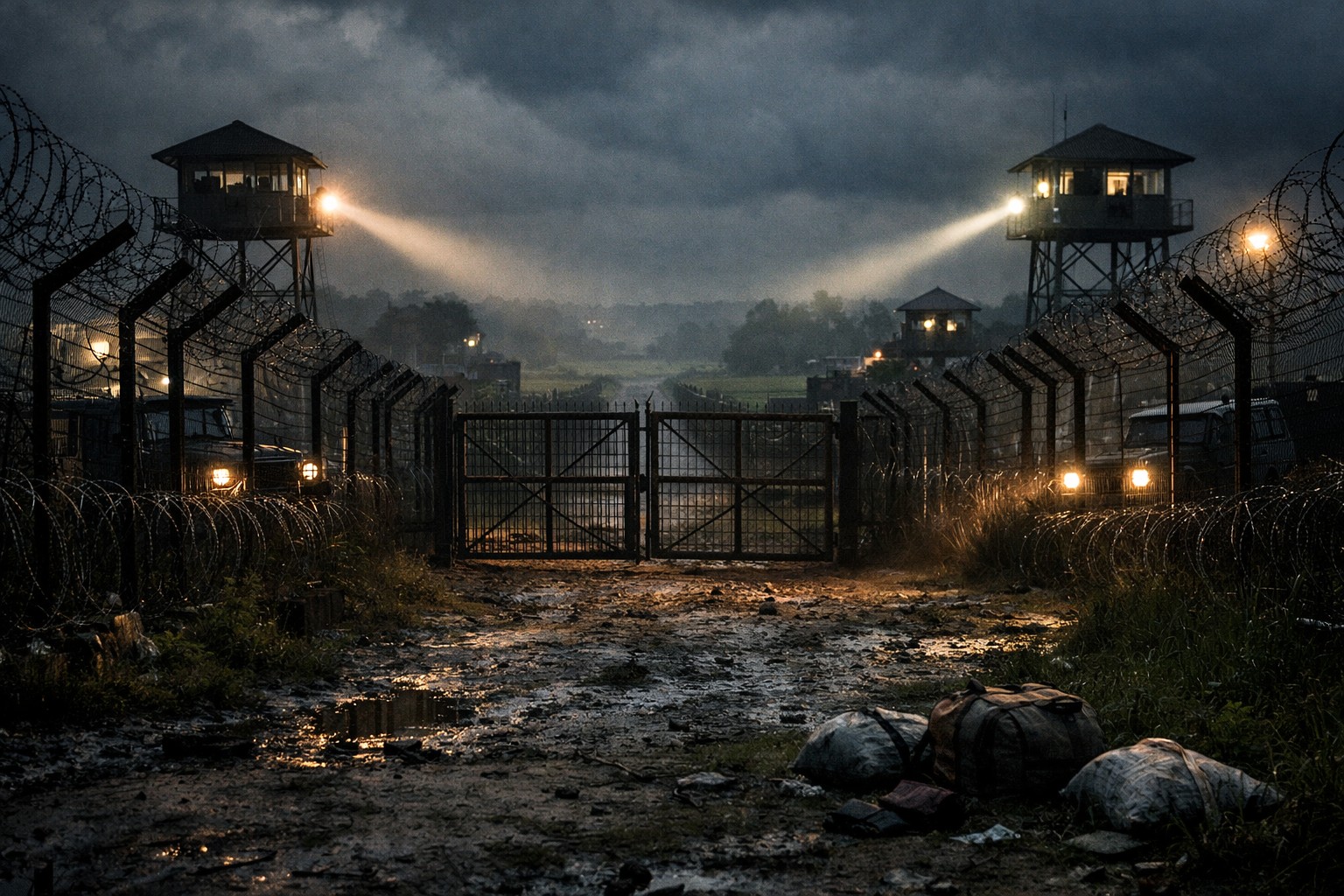
Bangladesh Says It Blocked Indian Pushbacks Along Tense Border
Bangladesh has accused India of trying to push people across their shared frontier in a series of recent incidents, opening a new flashpoint between neighbors whose ties are already under strain. Bangladeshi officials said border guards had foiled multiple attempts by Indian authorities to force individuals into Bangladesh, while New Delhi has not publicly issued a detailed response to each allegation. The dispute has revived long-running anxieties over irregular migration, citizenship and the hardening of one of South Asia's most politically sensitive borders. It also lands at a delicate moment for bilateral relations, with political mistrust deepening after months of turbulence in Dhaka.
Border Standoff Deepens
Officials in Dhaka said several attempted push-ins were detected in frontier districts in recent days, prompting Bangladesh border personnel to intervene and stop people from entering. The Border Guard Bangladesh, or BGB, said it had increased vigilance in areas considered vulnerable to unauthorized crossings and had warned Indian counterparts against any unilateral action. The allegations, reported by Reuters, center on claims that Indian border forces or local authorities sought to move people into Bangladeshi territory without due process.
The episodes are politically charged because both countries have spent years arguing over who belongs on which side of a border that stretches more than 4,000 km, cutting through rivers, farmland and densely populated communities. Bangladesh says any transfer of people must follow established diplomatic and legal channels, including verification of identity and nationality. Indian authorities have long maintained that illegal migration from Bangladesh is a serious domestic issue, particularly in border states where the subject carries electoral weight.
There was no immediate independent confirmation of the number of individuals involved in the latest incidents, and details remained fluid. Still, the accusations were serious enough to draw attention in both capitals, where border management has often been treated as a test of broader political trust. For residents in frontier communities, the dispute is less abstract: sudden detentions, identity checks and rumors of expulsions can spread fear quickly.
Migration Politics Haunt Ties
The argument over alleged pushbacks cannot be separated from a much older debate in India over undocumented migrants, especially those believed to have entered from Bangladesh. The issue has been central in the northeastern state of Assam for decades, feeding protests, court battles and large-scale citizenship verification exercises. In recent years, the publication of Assam's National Register of Citizens left nearly 1.9 million people off the list in a draft process that triggered concern over statelessness, though legal proceedings continued and many cases remained unresolved.
India's 2019 Citizenship Amendment Act, which eases citizenship for some non-Muslim migrants from neighboring countries, sharpened Bangladeshi unease despite Indian assurances that the law was an internal matter. Critics in Bangladesh and beyond said the law, taken together with citizenship screening measures, raised the possibility that people unable to prove status in India could be cast as Bangladeshis without evidence. Indian officials denied any plan to deport people arbitrarily across the border, but the fear never entirely receded.
The border itself has long been a site of friction. Rights groups, including Human Rights Watch and Indian civil liberties advocates, have documented killings, beatings and alleged abuses linked to anti-smuggling and anti-migration operations over the years. Even when relations between New Delhi and Dhaka were warm, the frontier remained one of the region's most militarized and contested spaces.
Dhaka Demands Due Process
Bangladeshi authorities have framed the latest incidents as violations of bilateral norms and international practice. Officials say that if any individual is believed to be a Bangladeshi national, proof must be established first through formal mechanisms rather than through abrupt removals at the fence line. The BGB has said it is in communication with India's Border Security Force, or BSF, to prevent escalation.
"No one can be pushed into Bangladesh without verification and proper procedure," a Bangladeshi security official said in comments carried by local media and cited in regional reporting.
Dhaka's position reflects a broader concern that summary returns create a dangerous precedent in a region where documentation is often incomplete and generations of cross-border movement have blurred family histories. Lawyers who work on citizenship and migration cases say mistaken identity is a genuine risk, especially among impoverished communities with limited paperwork. Once someone is deposited at a border point and disowned by both sides, legal remedies can become extremely difficult.
Bangladeshi officials have also tried to separate ordinary border management from the politics surrounding migration narratives in India. Publicly, they have insisted that Bangladesh should not be used as a destination of convenience for people whose nationality has not been established. Privately, according to analysts and former diplomats, Dhaka worries that isolated incidents can quickly become normalized if they are not challenged early.
India's Domestic Pressures Spill Over
For Indian leaders, irregular migration is tied to security, welfare spending and identity politics, especially in Assam, West Bengal and Tripura. Political parties across the spectrum have invoked the issue, though the rhetoric has been strongest among Hindu nationalist groups that argue demographic change threatens local communities. That domestic pressure can create incentives for visibly tough border action, even when legal complexities make removals difficult.
The BSF has not always publicly detailed its handling of such cases, but India has consistently argued that fencing, surveillance and stronger patrols are necessary to curb trafficking, smuggling and unauthorized movement. India has fenced much of the Bangladesh frontier, though rivers and enclaves have historically complicated enforcement. In some sectors, local residents cross frequently for farming or family reasons, blurring the line between criminal movement and traditional livelihoods.
- India and Bangladesh share a border of about 4,096 km, one of the world's longest land frontiers.
- The boundary touches five Indian states: Assam, Meghalaya, Tripura, Mizoram and West Bengal.
- Migration from Bangladesh has been a recurring political issue in India for decades, especially in Assam and West Bengal.
- Both countries have expanded fencing and surveillance, but densely populated terrain makes enforcement difficult.
Analysts say the problem is not simply one of border control, but of governance. Poor record-keeping, overlapping jurisdictions and strong political incentives produce a combustible mix. When tensions rise between the two governments, local confrontations can take on outsized diplomatic significance.
Relations Sour After Upheaval
The allegations come at a time when Bangladesh-India relations are markedly more fragile than they were just a year ago. India had built close ties with former Prime Minister Sheikh Hasina, whose government cooperated extensively with New Delhi on security and connectivity. But Bangladesh's political landscape was shaken after a mass uprising in 2024 forced Hasina to flee, ushering in an interim administration that has sought to rebalance foreign relations while facing domestic instability.
That transition has injected mistrust into a relationship once held up as a regional success story. India remains wary of political volatility and the possible rise of anti-India sentiment in Bangladesh. Bangladeshi public opinion, for its part, has become more vocal in questioning whether New Delhi backed an overly centralized and unpopular political order.
"The border issue is never just about the border," said an academic in Dhaka who studies South Asian diplomacy. "It reflects the political mood in both capitals and the degree of confidence they have in each other."
Trade, power links and transit cooperation still bind the two countries together. India is a major regional partner for Bangladesh, and cross-border road, rail and energy projects have continued despite political strains. Yet the latest accusations underscore how quickly unresolved grievances can resurface when the wider relationship loses its cushion of trust.
Lives Caught in the Middle
For people living near the frontier, disputes between governments often translate into immediate danger. Farmers work fields near fences, smugglers exploit poverty, and families split by partition and later wars still maintain ties on both sides. In that environment, a nationality dispute is not a matter of abstract sovereignty but of whether a person can return home, obtain work, or avoid detention.
Rights advocates say alleged pushbacks are especially troubling because they can leave vulnerable people stranded in legal limbo. Statelessness or disputed nationality often affects the poor most severely, including day laborers, minority communities and those lacking birth certificates or land records. Women and children are at particular risk when they are caught in enforcement operations without access to lawyers or consular support.
- Human rights groups have for years criticized the use of lethal force and harsh tactics along stretches of the India-Bangladesh border.
- Citizenship disputes in India's northeast have raised concerns about detention, deportation and statelessness.
- Bangladesh has insisted that any repatriation must be based on verified nationality and bilateral coordination.
Researchers say the region needs stronger safeguards, including transparent lists of detainees, independent monitoring and timely access to legal review. Without those checks, allegations of coercive removals are difficult to verify and even harder to remedy. That opacity has allowed distrust to fester for years.
Diplomacy Faces Another Test
The immediate question is whether the two sides can contain the dispute through border-level talks or whether it will escalate into a broader diplomatic row. Such incidents are often handled through flag meetings between local commanders, followed by exchanges between home ministries and foreign offices. If each side digs in publicly, though, the issue can quickly become a symbol of national resolve.
Experts say both governments have practical reasons to prevent further deterioration. Bangladesh needs a stable relationship with its largest neighbor as it navigates economic pressures, post-crisis politics and the continued burden of hosting more than 1 million Rohingya refugees from Myanmar. India, meanwhile, wants a cooperative eastern flank as it seeks to secure trade corridors, manage regional competition with China and prevent instability from spilling across borders.
"There is a tested mechanism for handling contentious border incidents, but it depends on both sides accepting verification rather than unilateral action," said a former South Asian diplomat familiar with India-Bangladesh negotiations.
Whether that mechanism holds may depend on what emerges about the latest allegations. If Bangladesh produces evidence of repeated attempts to force people over the line, pressure will grow for a formal protest and a clearer Indian explanation. If the two sides quietly resolve the cases, the episode may still leave behind a familiar lesson: on one of Asia's most crowded frontiers, the politics of identity can turn a local confrontation into a diplomatic crisis with remarkable speed.
Disclaimer: This content is aggregated from verified external sources for global news and information purposes only.